terça-feira, 10 de maio de 2011

[Nos dois berços]

Hércules Luta Com as Serpentes, @ Casa dei Vettii, Pompeia.
Nos dois berços
duas jibóias
esfomeadas
fugidas do circo
uma em cada berço
atacam os meninos
Hércules demove as jibóias
dos seus intentos assassinos
com monossílabos
dialogantes
à maneira de Konrad Lorenz
com os gansos
as jibóias adormecem
a pouco e pouco monas
enroscadas uma na outra
no berço de Íficles
como as lésbicas de Courbet
Íficles chora
com o peso das jibóias
sobre si
mas Hércules
dialoga com ele
como fez com as jibóias
e acalma-o
Íficles aprende com Hércules
a dizer Ji-Ji
para significar jibóia
monossílabo que pronunciam amboas
muito antes de papá
e de mamã

Adilía Lopes, A Continuação do Fim do Mundo
in Dobra - Poesia Reunida; Assírio & Alvim, Lisboa: 2009.

segunda-feira, 9 de maio de 2011

Purple Anemones

Who gave us flowers?
Heaven? The white God?

Nonsense!
Up out of hell,
From Hades;
Infernal Dis!

Jesus the god of flowers?
Not he.
Or sun-bright Apollo, him so musical?
Him neither.

Who then?
Say who.
Say it -- and it is Pluto,
Dis,
The dark one,
Proserpine's master.

Who contradicts?

When she broke forth from below,
Flowers came, hell-hounds on her heels.
Dis, the dark, the jealous god, the husband,
Flower-sumptuous-blooded.

Go then, he said.
And in Sicily, on the meadows of Enna,
She thought she had left him;
Hut opened around her purple anemones,
Caverns,
Little hells of colour, caves of darkness,
Hell, risen in pursuit of her; royal, sumptuous
Pit-falls.

All at her feet
Hell opening;
At her white ankles
Hell rearing its husband splendid, serpent heads,
Hell purple, to get at her --
Why did he let her go?
So he could track her down again, white victim.

Ah mastery!
Hell's husband blossoms
Out on earth again.

Look out, Persephone!
You, Madame Ceres, mind yourself, the enemy is upon you.
About your feet spontaneous aconite,
Hell glamorous, and purple husband tyranny
Enveloping your late enfranchised plains.

You thought your daughter had escaped?
No more stockings to darn for the flower roots, down in
hell?
But ah my dear!

Aha, the stripe-cheeked whelps, whippet-slim crocuses,
At 'em, boys, at 'em!
Ho golden-spaniel, sweet alert narcissus,
Smell 'em, smell 'em out!

Those two enfranchised women.

Somebody is coming!
Oho there!

Dark blue anemones!
Hell is up!
Hell on earth, and Dis within the depths!

Run, Persephone, he is after you already.

Why did he let her go?
To track her down;
All the sport of summer and spring, and flowers snap
ping at her ankles and catching her by the hair!
Poor Persephone and her rights for women.

Husband snared hell queen,
It is spring.

It is spring,
And pomp of husband-strategy on earth.

Ceres, kiss your girl, you think you've got her back.
The bit of husband tilth she is,
Persephone!

Poor mothers-in-law!
They are always sold.

It is spring.

D. H. Lawrence, Birds, Beasts & Flowers!, Black Sparrow Press, 1992.

Sobre o Comércio da Poesia, e a Ilíada

La transmission de la fausse grandeur à travers les siècles n'est pas particulière à l'histoire. C'est une loi générale. Elle gouverne aussi par exemple les lettres et les arts. Il y a une certaine domination du talent littéraire sur les siècles qui répond à la domination du talent politique dans l'espace; ce sont des dominations de même nature, également temporelles, appartenant également au domaine de la matière et de la force, également basses. Aussi peuvent-elles être un object de marché et d'échange.

L' Arioste n'a pas rougi de dire à son maître le duc d'Este, au cours de son poème, quelque chose qui revient à ceci: Je suis en votre pouvoir pendant ma vie, et il dépend de vous que je sois riche ou pauvre. Mais votre nom est en mon pouvoir dans l'avenir, et il dépend de moi que dans trois cents ans on dise de vous du bien, du mal, ou rien. Nous avons intérêt à nous entender. Donnez-moi la faveur et la richesse et je ferai votre éloge.

Virgile avait bien trop le sens des convenances pour exposer publiquement un marché de cette nature. Mais en fait, c'est exactement le marché qui a eu lieu entre Auguste et lui. Ses vers sont souvent délicieux à lire, mais malgré cela, pour lui et ses pareils, il faudrait trouver un autre nom que celui de poète. La poésie ne se vend pas. Dieu serait injuste si l'Énéide, ayant été composée dans ces conditions, valait l'Iliade. Mais Dieu est juste, et l'Énéide est infiniment loin de cette égalité.

Simone Weil, L'Enracinement, p. 293-4
Gallimard, Paris: 1949.

domingo, 8 de maio de 2011

Três Meses de Teatro Clássico


É no Teatro Paulo Quintela, na Faculdade de Letras da Universidade de Coimbra (FLUC), que, desde 1992, a Thíasos – Associação Cultural faz o que melhor sabe: trabalhar textos de autores clássicos. Sejam comédias ou tragédias, latinas ou gregas, o objectivo é a difusão da cultura clássica, momento que atinge o clímax com o Festival Internacional de Teatro de Tema Clássico. Apesar do orçamento limitado já se contam treze edições e a de 2011 começou a percorrer o país a 28 de Abril, com uma primeira palavra de Terêncio.

continuar a ler aqui.

The Messiah Codex Decoded (ou a história de uma falsificação)

"Are Lead Tablets Discovered in a Remote Cave in Jordan the Secret Writings About the Last Years of Jesus?” the Daily Mail wondered. “A group of 70 or so ‘books’, each with between five and 15 lead leaves bound by lead rings, was apparently discovered in a remote arid valley in northern Jordan somewhere between 2005 and 2007 ... They could, just possibly, change our understanding of how Jesus was crucified and resurrected, and how Christianity was born”: thus the BBC’s religious affairs correspondent. “Containing cryptic messages in Hebrew and Ancient Greek, the codices were etched in an indecipherable code”, added the Daily Telegraph. “Academics speculate that they are actually the lost collection of codices mentioned in the Bible’s Book Of Revelation . . . [they] appear to refer to the Messiah and possibly even to the Crucifixion and Resurrection”: the Mail again.

Continuar a ler aqui.

sábado, 7 de maio de 2011

O Livro na Cosmópolis — Colóquio Internacional Por Ocasião dos Dois Anos de Actividade dos Classica Digitalia

No dia 9 de Maio de 2011 estará aberta ao público, na Sala de Leitura do Instituto de Estudos Clássicos, uma exposição dos 50 volumes dos Classica Digitalia publicados, desde a criação, em 2009, deste espaço editorial do Centro de Estudos Clássicos e Humanísticos. Para além da sua publicação no ciberespaço podem, assim, ser apreciados os livros em suporte de papel. A exposição terá a sua abertura às 10h.

10h- Inauguração da exposição.
10h30m- Defense and Deterrence in the Context of the Foundation of the Delian League, Tomas Figueira (Univ. Rutgers)
11h30m - Alexandria: entre o Museu e a Biblioteca, Maria Helena da Rocha Pereira (Univ. Coimbra)
12h30m - La Bibliothèque de Montaigne, Marie-Luce Demonet (Univ. de Tours)

13h30m - Pausa para Almoço

15h - Apresentação da tradução da Historia Augusta (trad. José Luís Brandão, Univ. Coimbra, Cláudia Teixeira, Univ. Évora, Nuno Simões Rodrigues, Univ. Lisboa), por Maria Cristina Pimentel (Univ. Lisboa).
Apresentação da nova edição de J. Geraldes Freire, Apophthegmata Patrum, 2 vols., (com posfácio de Paula Barata Dias, Univ. Coimbra), por Arnaldo do Espírito Santo, Univ. Lisboa.
Apresentação do projecto de edição luso-brasileira dos Classica Digitalia, por Gabriele Cornelli (Univ. Brasília)

16h30m - Encerramento: Filosofia e Filopolítica em Platão: sobre Cercas Filosóficas e sua Permeabilidade, Gabriele Cornelli (Univ. Brasília).

sexta-feira, 6 de maio de 2011

Dar Uma Voltinha Em Herculano

For more than 20 years the Decumanus Maximus has been closed to visitors. But at a ceremony at the site it was returned to the public. "Most of Herculaneum as experienced by tourists consists of little narrow streets where people could virtually lean across from balcony to balcony and touch hands," Wallace-Hadrill said. "But the Decumanus Maximus is a big public space. It's impressive." Its reopening marks the latest stage in the steady recovery and restoration of a settlement less well-known but in some respects more fascinating than Pompeii. Both were preserved by the eruption of Vesuvius in AD79.

Herculaneum was rediscovered by chance in the early 18th century. By 2001, when the Herculaneum Conservation Project (HCP) was launched, the partially excavated site was in a pitiful condition: two-thirds of its area was closed to visitors for reasons of either safety or conservation. By the end of next year the HCP hopes to have reduced that proportion by half. The project has consolidated the escarpment that towers over the town, stabilised all but a handful of the ancient buildings, repaired most of the existing roofing and reinstated the original Roman drainage system, providing an outlet for water that once accumulated on the site and threatened to destroy it.

ler notícia completa aqui.

quinta-feira, 5 de maio de 2011

I Aniversário

Este blogue faz hoje um ano. Relendo a declaração de propósitos inicial, parece-me que nos mantivemos fiéis ao prometido. A Origem conquistou para si um espaço na Rede, empenhada numa missão que nos parece cada vez mais válida. Os números não são displicentes: 729 posts e pouco mais de 18.000 visualizações são valores minimamente consideráveis para um blogue de tema tão específico (porém tão amplo). Esperamos continuar a crescer com a mesma qualidade. A fortuna favorece os audazes.

terça-feira, 3 de maio de 2011

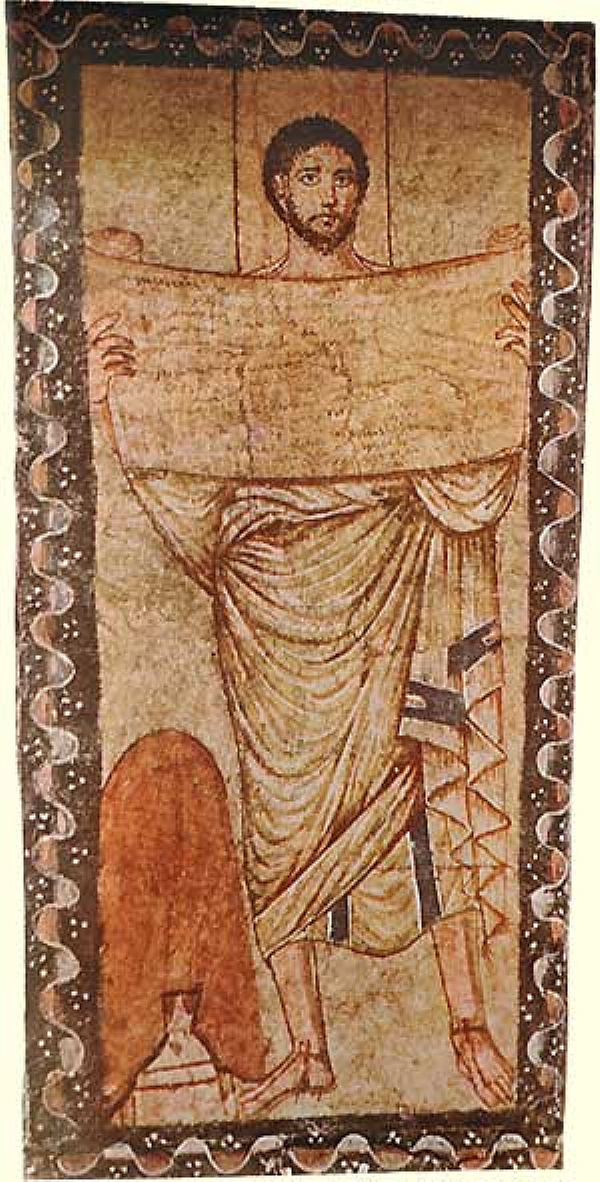
Três Frescos da Sinagoga de Dura-Europos


A sinagoga de Dura-Europos data de 244. É única porque nas suas paredes se descobriu uma extensa colecção de frescos. Aqui ficam três exemplos.